


 Some days ago I finished writing an article about combination planes and their uses for the Italian woodworking magazine Legnolab. Was this an occasion for a job I had in mind for some time, regarding a not so common combination plane, the Lewin Universal Plane. The Lewin plane was a British tool sold around 50s. Very close to Stanley 45 and 50, is featured by an aluminium body onto which steel skates are fixed. Another particular feature are the cam bolts; they permit a faster and easier part fixing. The plane I acquired was in excellent conditions, complete of all cutters and original instruction manual.The original wooden box (it came with the plane too), instead, came in poor condition.
 Clearly, the box was been stored in a very wet site and the moisture was an hard test for the wood, causing the inevitable damages Either the plane than cutters, instead, came in very fair conditions, rust free, due to a thick grease layer I found onto the plane and blades: someone payed particular attention to the precious box content: Thank you!
  So, I decided of restoring the box, preserving as well as possible the time signs which give a beautiful lived look. The first operation was to disassemble parts. The nails were very thin and rusted, so their recovery was quite impossible. I provided to repair splits and, where necessary, I added pine wood for restoring original dimensions.
  Original side joints were pinned rebates but, due to the poor wood condition at extremities, I preferred simple rebate joints. For the purpose I added a little bit of new wood and nails for more strength.
 I unglued the cover upper veneer and reglued it onto a piece of 4 mm plywood.The new bottom was veneered on both sides with a pine veneer on the upper side and a beech one on the bottom side: the original bottom had a similar structure.
 For veneering I used hide glue and pressed the work between two boards for 24h.
 The box inside showed some critical points: the cutter box, obtained from a pine block was glued cross-grained to a corner. This probably contributed to the box splitting. So, I preferred to leave it free on the bottom but stopped by two little wood pieces, glued with the grain in the correct orientation. In this choice is also possible to remove the cutter holder and keep it on the bench.
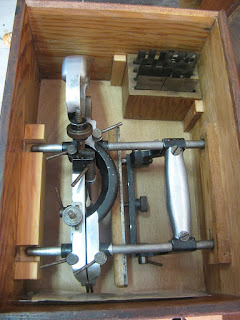 The plane holding system is clever and permits of keeping the plane assembled and lifted, so its weight does not act on the bottom. One holder was substituted end increased in thickness for offering more support to the rods. The instruction manual too has its place in the box, protected now by a plastic bag. On the external side I refreshed the original colour using a water based dye (a combination of cherry and rosewood dyes); a wax coat completed the box finishing.
 A particular was still missed:Looking at a box short side I noticed a little piece of paper, the remaining of the original label with plane description. A lighter coloured area established its dimensions.On the very good site Cornish Workshop I found a scanner of the label (and a lot of other precious info). I printed it and did a colour photostatic copy (my ink jet printer does not produce colours resistant enough for the purpose). In order to give an antique look, I used a diluted coffee solution in which the paper was soaked for several minutes and a microwave (1 min) for drying it. The final colour was right with some (good) stains due to the fast drying.
  The Lewin, is now inside its new old box, ready to work again.
Italian Planemakers
Jumat, 05 Februari 2016
The planemaker must have been a very common trade, mainly in the XIXth century, then it gradually disappeared in the first half of XXth century, while woodworking machines increased their diffusion. United States, United Kingdom, France and Holland are countries where the industrial plane production is well evidenced by the high number of planes it is possible to find still nowadays and detailed info about planemakers, available thanks to collectors too.
But, who were the Italian planemakers?
Often, Italian woodworkers, mainly in the South of Italy, used to make themselves wooden tools or, if they purchased them, these came from France and Germany. I would be able to tell about several English or American planemakers as well as someone German, but if you asked me about Italian ones, I think would have some difficult.
Guido Masoero helped me in this search. He is descendent from a family of wooden tool makers, mainly planes. His grandfather, Antonio Masoero (1872-1964) founded the U.M.A.T. (Utensili Masoero Antonio Torino), may be in the first years of XXth century. The factory was in Turin and the tradition continued by his sons Luigi and Eugenio. Unfortunately, a bomb destroyed forever the factory in july 1943 and only a 1934 price list survived in Guidos hands. His uncle, Eugenio, continued to build planes until 80s. Here are the last planes he made for fun.


This 1934 catalogue Guido kindly shared, has 15 pages and a complete plane set is listed as well as some saw, workbenches and other few tools.

Many bench planes have an unusual method to set iron and chipbreaker. This is not screwed to iron but it is placed between the wedge and plane abutements.
I could not say if there are advantages or disadvantages by using this configuration, even because I did not try this system before. Together with common ones, there are several special planes which captured my attention; is the case of a panel raiser plane with handle and three blades: the first one is for rebating, the second is the nicker and the third one task is to form the moulding along the inner edges. Never seen one like this. Fantastico!
How much was such a beauty cost in 1934? The price was variable in reference to wood used (leccio=holm oak, pomo=apple) and the blade mounted into.D.V.C.= Double iron with short screwD.V.L. =Double iron with long screw In 1934 the Lira had the best purchase power between WWI and WWII. With 30 lire it was possible to purchase a shoes pair. A bread piece cost 1.50 lire. So our plane today would cost about 50-80 Euro, a realistic (cheap too) price.
Turning the catalogue pages, other special models dont lack, as a tonguing and grooving plane, like that I showed in the previous post.

To be noticed is the open construction, simply to realize but that requires to pay attention to right blade insertion in order to maintain the correct geometries. This brief U.M.A.T. tour finish with a gelosie plane (dado plane). The "gelosie" are timber blinds with elements inserted in grooves cutting in the stiles.  This grooves are cut across the grain (in oblique direction) and the plane needs nickers for scoring the wood before the blade cutting.The groove width was variable between 8 and 12 mm.
This grooves are cut across the grain (in oblique direction) and the plane needs nickers for scoring the wood before the blade cutting.The groove width was variable between 8 and 12 mm. 
Listino U.M.A.T. 1934 (pdf)
Langganan:
Postingan (Atom)